A tenant looking for 8,000 square feet does not wake up wondering whether a metro has 6.2% industrial vacancy.
They want to know whether there is an 8,000-square-foot suite they can actually use: somewhere with a door, enough power, reasonable parking, a workable truck path, a location their people can reach, and permission for the business they run.
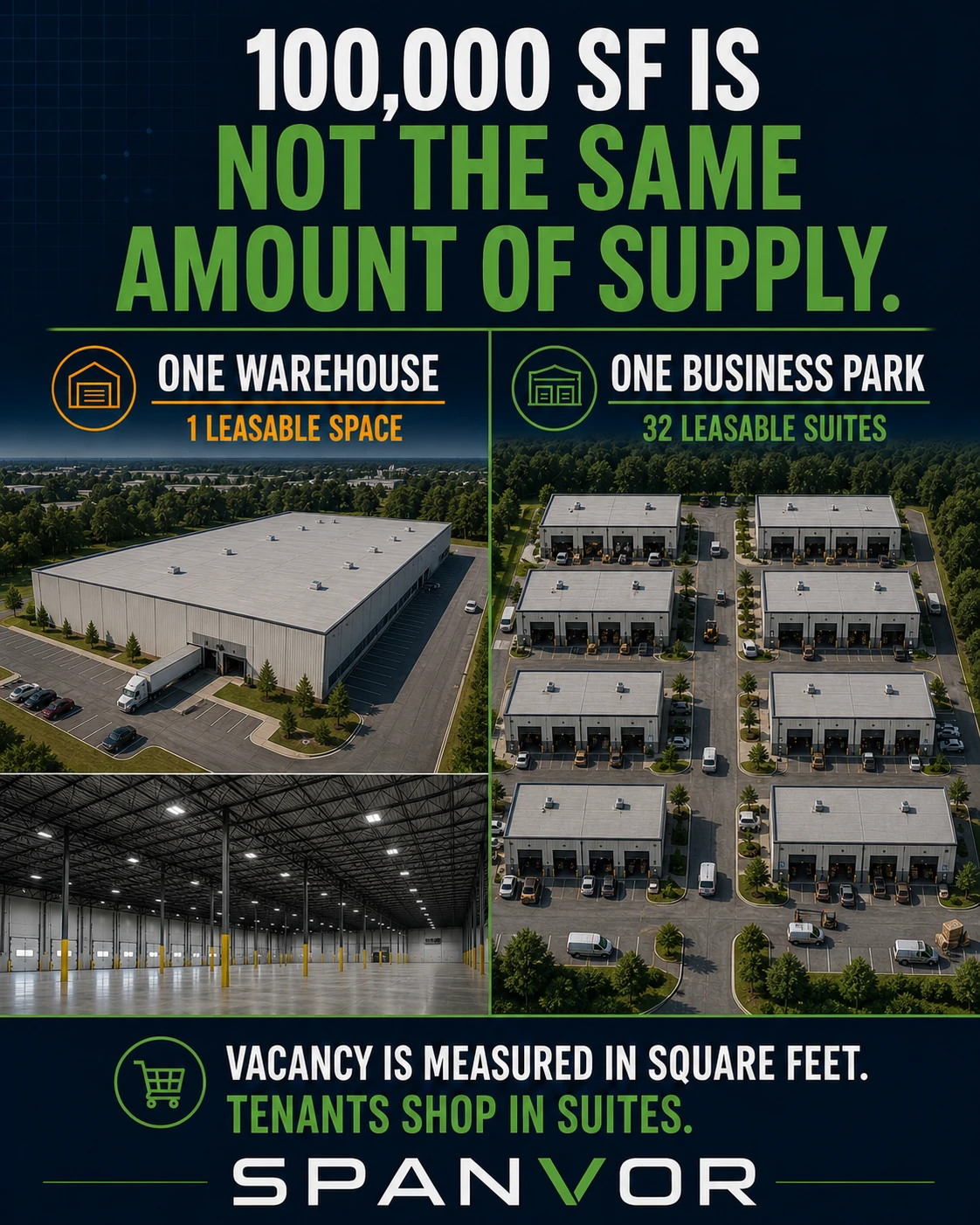
That is why a 100,000-square-foot business park and a 100,000-square-foot warehouse are not the same amount of supply.
One may be a single large lease decision. The other may be thirty-two smaller decisions, each with its own tenant, door, panel, parking pattern, expiration date, and next leasing opportunity.
Vacancy is not wrong. It is simply answering a broader question than the one a small-bay tenant is asking.
What does industrial vacancy actually measure?
Industrial vacancy measures empty square footage relative to total square footage. It is useful. It tells us something about aggregate capacity, landlord negotiating leverage, and whether a market is absorbing more space than it is delivering.
But square footage is not a unit of choice for every tenant.
For a 4,000-, 8,000-, or 15,000-square-foot local operator, the unit of choice is the suite. A vacancy percentage does not tell that tenant:
- How many suites exist in the size range they need
- Whether any are available now or coming available soon
- Whether the suites have grade-level loading, sufficient power, or workable parking
- Whether the tenant can combine adjacent bays if it grows
- Whether the site can support its vehicles, deliveries, customers, equipment, or permitted use
The headline number still matters. It just stops short of the decision.
How can the same 100,000 square feet represent different supply?
Consider two illustrative properties. They have the same building area: 100,000 square feet.
The first is one distribution warehouse. It may have one tenant, one major expiration, and one large block of space if it becomes vacant.
The second is a small-bay business park. It may have eight buildings with four roughly 3,000-square-foot suites in each, for thirty-two suites in total. It has many more tenant choices, but also many more distinct spaces that can be full, vacant, combining, dividing, improved, or functionally constrained at any given time.
| Same building area | One warehouse | One small-bay business park | | --- | --- | --- | | Total building area | 100,000 SF | 100,000 SF | | Practical leasing unit | One large space | Many individual suites | | What a vacancy event may create | One large block | One or more smaller choices | | What the next tenant needs to know | Building-scale capability | Suite-scale capability plus shared-site utility | | What the owner manages | A concentrated lease decision | A portfolio of smaller lease decisions |
This is not a claim that every 100,000-square-foot park contains thirty-two suites. It is an illustration of the measurement problem.
A 100,000-square-foot warehouse could be technically vacant and still offer nothing to an 8,000-square-foot tenant. A business park could show only modest vacant square footage yet offer several practical choices for local businesses. Or it could show the same vacant square footage in bays that are poorly configured, underpowered, blocked by parking, or unusable for the next tenant's operation.
Why do tenants shop in suites instead of square feet?
Because small-bay tenants are not buying abstract area. They are buying a place to work.
An electrical contractor may need a modest office, grade-level loading, fleet parking, and a panel that can support equipment. A cabinet maker may care about a drive-in door, ventilation, and delivery access. A gym, gymnastics program, martial-arts school, or church may need clear height, parking, customer access, and an approvable use.
Two available 8,000-square-foot suites may be identical in a market report and completely different in the real world. One may be ready; the other may need new electrical service, loading work, a parking answer, or a zoning approval.
That is why the question, “How much industrial space is vacant?” eventually has to become, “Which suites can this tenant use?”
What should an owner, broker, or buyer ask instead?
I would not throw out the vacancy report. I would put better questions beside it.
- How much supply is available by suite-size band? A 50,000-square-foot block does not serve the same market as five 10,000-square-foot suites.
- How many practical choices does the tenant really have? Count the available suites, not only the total available area.
- What can the suite actually do? Look at loading, clear height, power, office finish, parking, access, yard utility, and permitted use.
- What happens at the property when the suite is occupied? A bay may look available and workable during a quiet tour but fail during the property's real peak period.
- What is coming next? Lease expirations, re-demising plans, tenant improvements, and building upgrades can matter as much as the current vacancy number.
This is not about making leasing more complicated. It is about admitting that a multi-tenant operating property is already more complicated than one large box, whether the market report captures it or not.
Why does this matter to small-bay investing?
The suite-level view changes both the opportunity and the work. A one-tenant warehouse vacancy can be a large, concentrated event. In a multi-tenant park, vacancies arrive in smaller pieces—more leasing work and more frequent decisions, but often a broader tenant base and less dependence on one business.
Neither arrangement is automatically better. They simply should not be treated as interchangeable because their building totals match. For an owner or buyer, the closer question to rent, downtime, capital needs, and operating risk is: “What are the next likely suites at this property, who can use them, and how many real alternatives do those tenants have?”
Why are we not publishing a national suite-vacancy number?
Because a useful national suite report needs suite-level coverage that is broad enough to deserve the conclusion.
Public property records are generally built around parcels and buildings, not individual bays. A marketing flyer may identify a suite while an assessor record does not. A lease plan may change without appearing in a public database. Availability is also a moving target: a suite can be occupied, marketed, under letter of intent, under construction, or physically unsuitable for the next use.
SpanVor is building more of that operating detail. But it would be easy—and unhelpful—to call a partial set of suite observations a national vacancy rate.
So, for now, this is a practical framework rather than a national scorecard. The better national study should wait until suite identifiers, size, availability status, physical capability, and dated coverage are deep enough to make the number meaningful.
That restraint is not a weakness. It is the difference between a useful measurement and an attractive-looking answer to the wrong question.
Frequently asked questions
Is building-level industrial vacancy useless for small-bay?
No. It is useful for understanding broad market capacity and direction. It becomes incomplete when it is used as a substitute for suite mix, functional fit, and the number of real choices a smaller tenant has.
Does a business park with more suites always have more useful supply?
No. More suites create more potential choices, but the choices still need the right size, configuration, loading, power, parking, access, and permitted use. A suite count without functional detail can be misleading too.
What should a small-bay tenant ask a broker?
Ask for the actual suite sizes, current and upcoming availability, loading, power, office finish, parking, vehicle circulation, permitted use, and any limitations that would affect the operation after move-in.
What should a small-bay buyer track?
Track the physical suite mix, tenant activity, expirations, re-leasing history, functional capability, site constraints, and the supply of comparable suites—not just the market's total vacant square footage.
Key takeaways
- Industrial vacancy measures empty square footage; small-bay tenants shop for usable suites.
- Two properties with the same building area can offer radically different tenant choice and operating complexity.
- Suite size, loading, power, parking, access, and permitted use determine whether nominal supply is real supply for a tenant.
- Building-level vacancy remains useful, but it should sit beside suite-level questions.
- A credible national suite-vacancy report should wait for much broader, dated suite coverage.
For the wider argument about why small-bay behaves differently from the big-box headline, read the Small-Bay Industrial Investor Primer. For the property-level information a tenant or buyer should want next, use the Small-Bay Asset Passport and the Small-Bay Operating System Guide.
SpanVor is working to make the property, building, site, use, and occupancy details that change a decision easier to find and understand. You can explore public market context now, then unlock property-level precision with Pro.
One last thing, since you read this far: the code SpanvorBlog takes 25% off a SpanVor Pro subscription—where the parcel-level data behind posts like this one actually lives.
Written by Jason Probert, Founder of SpanVor.