What more than 2,200 advertised industrial and flex offerings reveal across Jacksonville, Tampa Bay, Orlando and South Florida
Put the same 3,000-square-foot industrial requirement in Jacksonville and Miami.
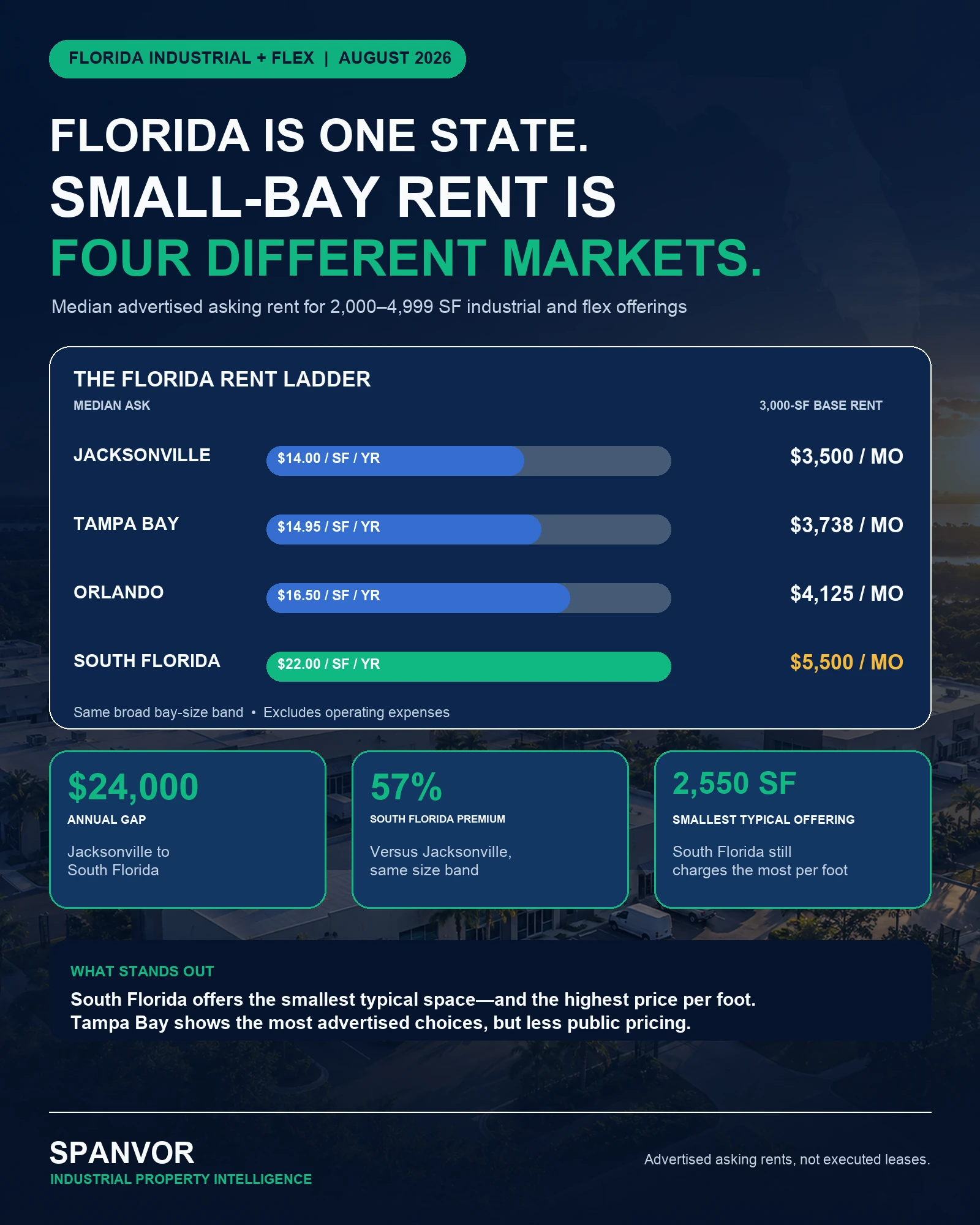
At the median advertised asking rents for 2,000-to-4,999-square-foot space, the Jacksonville bay works out to about $3,500 a month in base rent. The South Florida bay works out to about $5,500.
Same amount of space. Roughly $2,000 a month—or $24,000 a year—between them before operating expenses, utilities, concessions or improvements enter the conversation.
Tampa Bay and Orlando fill in the steps between the two. At the same 3,000-square-foot illustration, Tampa Bay lands near $3,738 a month and Orlando near $4,125.
That is the first lesson from SpanVor’s August 2026 review of four major Florida industrial and flex leasing markets: Florida is one state, but it is not one leasing market. It is a rent ladder.
Four price tags for the same-sized requirement
Comparing metro-wide rent figures can be misleading because each market advertises a different mix of suite sizes. Smaller bays usually command more per square foot. A market with more small suites can therefore look expensive even when geography is not the reason.
So I narrowed the comparison to offerings between 2,000 and 4,999 square feet—the range that captures a practical requirement for many contractors, repair businesses, local distributors, light manufacturers, fitness operators and other small-bay users.
| Market | Median ask, 2,000–4,999 SF | Average ask, 2,000–4,999 SF | Priced offerings | Approx. monthly base rent at 3,000 SF | |---|---:|---:|---:|---:| | Jacksonville | $14.00/SF/year | $15.60 | 92 | $3,500 | | Tampa Bay | $14.95 | $15.08 | 161 | $3,738 | | Orlando | $16.50 | $17.22 | 96 | $4,125 | | Miami–Fort Lauderdale | $22.00 | $23.30 | 177 | $5,500 |
The South Florida premium does not disappear after controlling for suite size. Its median is about 57% above Jacksonville, 47% above Tampa Bay and 33% above Orlando in the same broad bay-size band.
The averages tell the same general story, reducing the chance that a quirk in the median is carrying the conclusion.
South Florida’s smallest typical offering carries the highest price
The result I find most interesting is not simply that South Florida costs more. It is that its advertised inventory is also the most divisible.
Across the qualifying industrial and flex offerings we reviewed, the median marketed size was approximately:
- 2,550 SF in Miami–Fort Lauderdale
- 4,000 SF in Orlando
- 5,000 SF in Jacksonville
- 5,000 SF in Tampa Bay
South Florida presents the smallest typical bite of space while charging the highest price per foot.
In a dense, land-constrained region, a business may find a smaller commitment but still pay for the right to be small. Divisibility, infill access and proximity to customers, employees and suppliers all have value. A smaller suite can reduce the total monthly check even while carrying an expensive rate per foot. The landlord sees $22 per foot; the tenant sees whether the all-in payment fits inside the business.
Tampa Bay offers the most choices—and the least visible pricing
Tampa Bay contained the largest advertised pool in the four-market review: more than 850 qualifying industrial and flex offerings. South Florida followed with more than 500, while Jacksonville and Orlando each had more than 400.
But Tampa Bay published a usable asking rent on only about 43% of those offerings. South Florida published a rent on nearly 79%.
That does not explain why Tampa is cheaper. It means its rent conclusion rests on a narrower portion of a much larger advertised pool. In the controlled size band, the public-pricing share improves to about 62%. The number of choices and the number of priced choices are still not the same thing.
The metro averages hide several Floridas inside Florida
The north-to-south ladder is real, but it is not a clean interstate toll schedule. Submarkets regularly break the pattern.
Northeast Florida: St. Augustine does not price like Jacksonville
Among 2,000-to-4,999-square-foot offerings with public asking rents, Jacksonville proper had a median of $12.50/SF/year across 55 observations. St. Augustine was $15.95 across 15.
For a 3,000-square-foot bay, that is approximately $3,125 a month in Jacksonville versus $3,988 in St. Augustine—an $863 monthly difference inside the same broader region.
The snapshot cannot divide that premium among growth, coastal geography, limited industrial land and building quality. It can show that “Jacksonville rent” is too blunt for an owner or tenant working in St. Johns County.
South Florida: the most expensive metro still has a wide internal spread
The controlled-size medians were approximately:
| South Florida submarket | Median ask, 2,000–4,999 SF | Priced offerings | |---|---:|---:| | West Palm Beach | $28.00/SF/year | 22 | | Miami | $25.39 | 24 | | Pompano Beach | $22.25 | 12 | | Fort Lauderdale | $18.00 | 21 |
The South Florida headline is $22. A tenant’s actual search can begin six dollars below that figure in one major city and six dollars above it in another.
Building quality, office finish, doors, power, parking, yard, lease structure and exact location remain unadjusted. But the samples make one point safely: South Florida’s premium is not evenly distributed.
Tampa Bay: crossing the bay can change the check
Tampa proper and St. Petersburg were close in the controlled band, at approximately $15.95 and $16.00/SF/year. Largo came in near $16.65. Clearwater was $13.00, and Tarpon Springs was $12.00.
Tampa Bay is a collection of operating geographies divided by water, bridges, commute times and different stocks of industrial buildings. A tenant does not lease “Tampa Bay.” It leases the bay that works on the correct side of the trip.
Orlando is the middle market—but not a generic one
Orlando sits between South Florida and the two lower-cost metros in the controlled comparison. That can make it look like the easy midpoint. Its size curve says more.
The median advertised ask was approximately $18.38/SF/year below 2,000 square feet, $16.50 from 2,000 to 4,999 square feet and $15.00 from 5,000 to 9,999 square feet.
In other words, Orlando’s very small bays carried a visible premium. That is exactly where the most price-sensitive users often shop: young service businesses, specialty trades, local ecommerce operations and operators moving out of garages or storage units.
The rate may be modest beside Miami. The entry cost can still be difficult for the business that needs only 1,500 square feet and cannot substitute a 20,000-square-foot warehouse.
What the ladder does—and does not—tell us
Florida’s major markets form a clear asking-rent ladder, and the South Florida premium remains after a basic suite-size control. Divisibility and affordability are different, and metro medians are only the first screen.
These are not executed rents. The offering counts are not vacancy, the listing pool is not complete availability and the pricing spread is not proof of demand. An advertised rent is the owner’s opening position; it does not reveal concessions, improvements, free rent or the final lease.
Nor is the cheapest bay automatically the best value. Weaker power, parking, loading, HVAC, office buildout or lease terms can erase an apparent discount. Price the bay only after confirming that it works.
Frequently asked questions
Which Florida market had the highest advertised small-bay asking rents?
Miami–Fort Lauderdale. In SpanVor’s August 2026 snapshot, the median asking rent for 2,000-to-4,999-square-foot industrial and flex offerings was $22.00/SF/year, compared with $16.50 in Orlando, $14.95 in Tampa Bay and $14.00 in Jacksonville.
What would a 3,000-square-foot bay cost in each market?
Using the controlled-band medians as a simple base-rent illustration: approximately $3,500 per month in Jacksonville, $3,738 in Tampa Bay, $4,125 in Orlando and $5,500 in Miami–Fort Lauderdale. These figures exclude operating expenses, taxes, insurance, utilities, concessions and tenant improvements.
Are these signed lease rates?
No. They are publicly advertised asking rents. Signed and effective rents may differ after negotiations, concessions and improvements.
Why compare 2,000-to-4,999-square-foot spaces?
The size control reduces one of the largest distortions in metro rent comparisons. Smaller spaces usually command higher rates per foot, so comparing similar-sized offerings provides a more useful view of geography. It does not control for every physical or lease difference.
How we counted
SpanVor reviewed publicly advertised industrial and flex lease offerings collected August 28–31, 2026 across the official market counties for Jacksonville, Tampa Bay, Orlando and Miami–Fort Lauderdale. The publishable cohort contains 2,249 offerings across approximately 883 marketed properties, after removing office-only and other non-industrial records, spaces below 1,000 square feet, out-of-market records and exact repeated observations. Approximately 1,283 offerings published a plausible annual asking rent.
The primary comparison uses 2,000-to-4,999-square-foot offerings with public asking rents. Medians describe the midpoint; averages are also shown because each measure reveals a different part of the distribution. The 3,000-square-foot monthly figures are illustrations based on annual base asking rent divided by twelve. They are not full occupancy-cost estimates.
Key takeaways
- A comparable 3,000-square-foot requirement carries an approximate $24,000 annual advertised base-rent gap between Jacksonville and South Florida.
- South Florida’s premium survives the suite-size control: $22.00/SF/year versus $14.00 in Jacksonville.
- Miami–Fort Lauderdale has the smallest median marketed suite and the highest rate per foot.
- Tampa Bay has the largest advertised offering pool, but fewer than half of its broader offerings publish a rent.
- Submarket differences can be as important as the metro ranking.
- Asking rents are the opening conversation—not executed rents, vacancy or measured demand.
Explore SpanVor’s public market profiles for Jacksonville, Tampa Bay, Orlando and Miami–Fort Lauderdale, or compare the broader Florida Industrial Data Atlas.
SpanVor tracks industrial properties, marketed space and development activity across the United States. Explore the public market context now, then unlock property-level precision with SpanVor Pro.
One last thing, since you read this far: the code SpanvorBlog takes 25% off a SpanVor Pro subscription—where the property-level data behind posts like this one lives.
Written by Jason Probert, Founder of SpanVor — Industrial Property Intelligence.