The most valuable part of a small-bay property may be the square footage without a roof.
A 12,000-square-foot building on several acres can look underbuilt in a spreadsheet. To a contractor, landscaper, equipment company, building-material supplier or fleet operator, the building may be the support structure. The yard is where the business happens.
That changes how the property should be described, toured and underwritten.
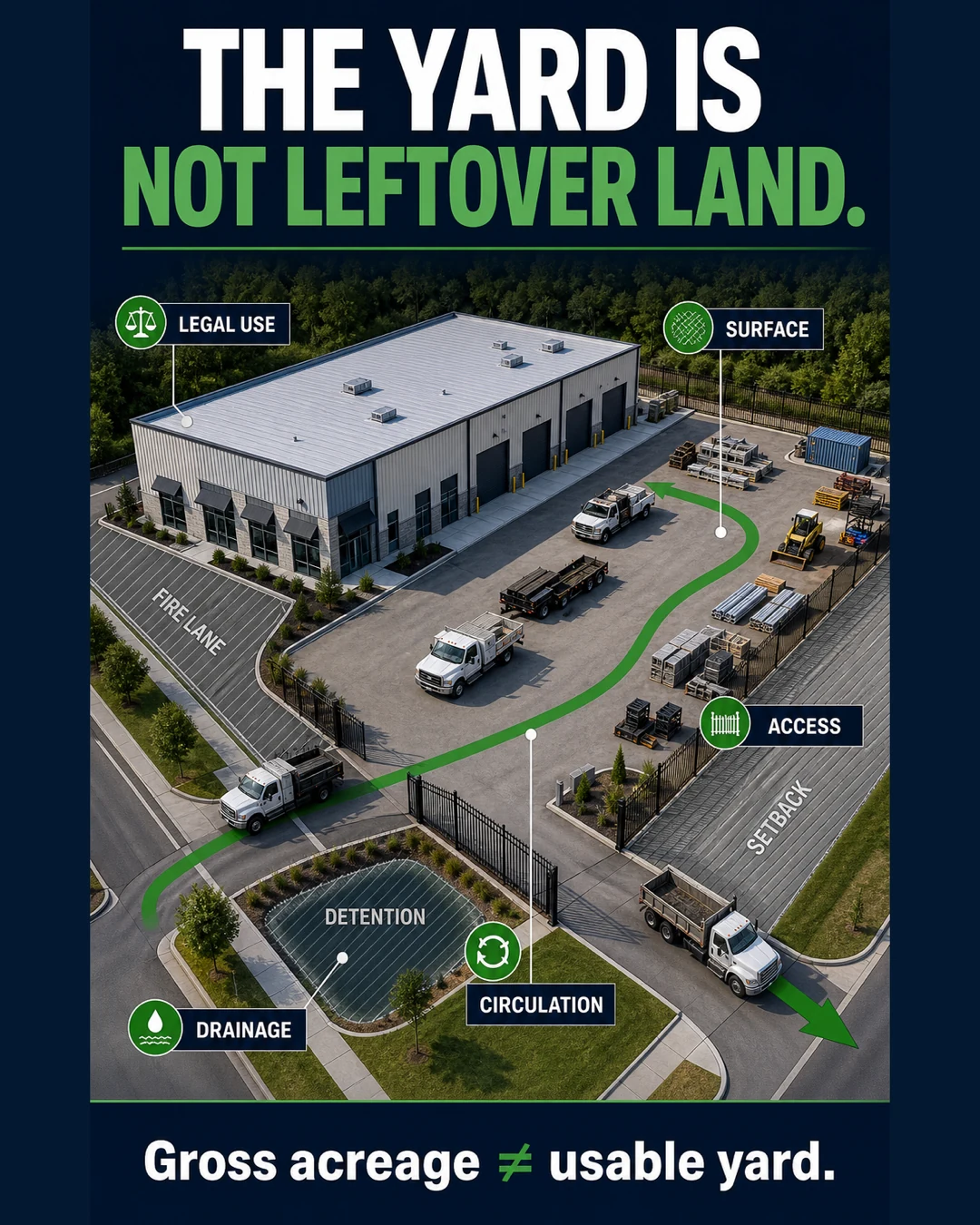
Too often, the yard is treated as a subtraction problem: parcel area minus building footprint equals open land. But open land is not necessarily usable yard. Some of it may be parking, fire lane, setback, detention, landscaping, easement or land a truck cannot reach. Some of it may look available while outdoor storage is restricted or prohibited.
The useful question is not, “How many acres does the property have?”
It is: How much of the site can the tenant legally and practically use to operate the business?
What is the difference between acreage and usable yard?
There are at least four different numbers hiding inside the word “yard.”
- Gross parcel area is everything inside the property line.
- Unbuilt area is what remains after the building footprint.
- Legally usable yard is the portion where the intended parking, staging or storage activity is allowed.
- Functionally usable yard is the portion that a tenant can actually reach, secure, drain, circulate through and use without blocking another part of the property.
A brochure might advertise three acres of land. A tenant may discover that the rear acre holds detention, one side is required for access and fire circulation, trailers cannot clear the gate, and outside storage needs approval that the current owner never obtained.
The acreage did not disappear. Its operating value did.
That is why a useful property description should identify the yard's approximate usable area, surface, shape, gates, fencing, access, drainage, lighting and permitted use—not merely the total lot size.
Why can a low-coverage property be more valuable as it is?
Real estate people are trained to see unused land as future building area. Sometimes that is exactly right. More rentable square footage can create value.
But low building coverage does not automatically mean the site is under-improved.
For a yard-driven user, adding another building can remove the feature that makes the property useful. A plumbing contractor may need room for service vans, pipe and trailers. A landscape company may need material bins, equipment parking and early-morning circulation. A rental business may need space to receive, inspect and stage machinery. A custom-vehicle or fleet operator may need secure overflow that cannot fit inside the shop.
In those cases, the open land is not waiting for a “higher use.” It is already productive operating space.
The right question is not whether more building can fit. It is whether the value of the additional building exceeds the value of the yard capacity it would consume.
Which tenants actually pay for yard utility?
Outdoor storage is often discussed as though it serves one narrow group of industrial tenants. The real user base is much wider.
Useful yard can matter to:
- Plumbing, electrical, HVAC and general contractors
- Landscaping, tree-service and irrigation businesses
- Utility, telecommunications and infrastructure crews
- Equipment rental, service and repair companies
- Building-material and specialty-product suppliers
- Fleet, towing, custom-vehicle and mobile-service operators
- Fabricators and installers handling bulky finished products
- Modular-building, event-production and temporary-structure companies
- Businesses that need secure trailer, container or work-vehicle staging
These users are not simply renting vacant dirt. They are buying time and operating flexibility. A practical yard can reduce double handling, off-site storage, vehicle shuttling and the daily friction of moving equipment through a site that was never designed for it.
What destroys yard utility?
The fastest way to overvalue a yard is to stop at the aerial photograph.
Legal use
A fence, gravel surface or existing pile of materials does not prove that outdoor storage is permitted. The activity may be allowed, conditional, limited by screening, tied to an older approval or simply tolerated. Confirm the intended use locally and understand whether a change in tenant changes the answer.
Surface and drainage
Gravel can be perfectly useful for one operation and unacceptable for another. Soft spots, dust, mud, standing water and poor base material can turn nominal acreage into seasonal acreage. Asphalt is not automatically better if it is failing under concentrated truck or equipment loads.
Access and circulation
Measure the complete movement, not just the gate opening. Can the vehicle turn from the street, stack without blocking traffic, clear the gate, reach the storage area, turn around and leave without backing through the entire site? A wide yard behind a narrow throat may have very little practical capacity.
Fire lanes, setbacks, security and neighbors
The cleanest open area on an aerial may need to remain open. Fire access, utility corridors, drainage, landscape buffers and setbacks can remove meaningful portions of the site from daily use. Fencing, gate control, lighting and visibility affect what can safely remain outside. So do adjacent homes, retail uses and other tenants.
Shared-site conflict
In a multi-tenant property, the yard cannot be evaluated in isolation. One user's trailers may block another tenant's loading. Customer parking may spill into a truck path. An informal storage area may work at 60% occupancy and fail when the last bays lease.
The yard has to work at the property's realistic operating peak, not just during a quiet tour.
How should the yard be toured?
Drive the path the tenant will drive.
Start at the public street. Turn in with the longest or least maneuverable vehicle the operation expects. Check gate width, stacking, grades and overhead conflicts. Follow the route to the storage or staging area. Test the turning movement and the path back out.
Then walk the edges. Look for drainage structures, soft ground, ponding, damaged paving, utility equipment, fire-lane markings, easements, fences, gates, lighting and evidence that neighboring users already compete for the space.
Ask the practical questions:
- What is stored or parked outside today?
- What does the lease allow?
- What does the local approval allow?
- Which area is assigned to this tenant, and is that assignment shown anywhere?
- Does the area remain usable after rain?
- Can vehicles enter and leave without moving someone else's equipment?
- Who maintains the surface, fence, gate and drainage?
- What happens when the property is fully occupied?
How should yard value be described?
Do not reduce the answer to “fenced yard” or “outside storage available.” Describe the operating capability.
A useful yard description might say:
Approximately 1.4 acres of fenced, lit and compacted outdoor area with two gated access points, practical trailer circulation and direct connection to the tenant's grade-level loading. Outdoor storage use and limits still require local confirmation.
The same details belong in the property's asset passport:
- Approximate gross and usable yard area
- Surface type and condition
- Gate count, width and control
- Fencing, lighting and security
- Vehicle path and turning constraints
- Drainage and flood observations
- Fire lanes, setbacks, detention and easements
- Permitted, observed and unverified outdoor activities
- Tenant allocation and shared-use rules
The bottom line
The yard is not the land the building failed to occupy.
For the right small-bay user, it is fleet parking, material storage, equipment staging, trailer circulation, overflow capacity and time saved every working day. It can be the reason a tenant chooses the property—and the reason replacing that property is difficult.
But gross acreage does not create that value by itself.
The value sits in the usable portion: legal, accessible, surfaced, drained, secure and compatible with the people operating next door.
The yard is not leftover land. It is operating space.
Frequently asked questions
Does a fenced industrial yard mean outdoor storage is legal?
No. Fencing and existing outdoor activity show how a site is being used, not necessarily what has been approved. Confirm the intended use, any conditions and whether the approval follows a new tenant or changed operation.
Is low building coverage always redevelopment potential?
No. It may create expansion potential, but the open area may also be the property's most useful feature. Any redevelopment analysis should compare the value of added building area with the yard utility it removes.
What makes an industrial yard functionally usable?
The intended operation needs suitable legal use, surface, drainage, access, turning space, security and separation from conflicting traffic or neighboring activities.
How should usable yard area be measured?
Begin with the parcel, then remove the building, required parking, fire access, detention, setbacks, easements, buffers and inaccessible or impractical areas. The remaining figure is still an estimate until the intended use and site operation are confirmed.
Key takeaways
- Gross parcel acreage is not the same as usable yard.
- Low building coverage can be productive operating capacity, not wasted land.
- Legal use, access, circulation, surface, drainage and security determine utility.
- Outdoor storage serves a broad group of local operating businesses.
- The yard should be documented as carefully as the building and suites.
- The best tour follows the tenant's vehicle path from the street, through the operation and back out.
SpanVor is working to make the property, building and site details that matter to industrial operators easier to find and understand. Explore the broader Small-Bay Asset Passport and Small-Bay Operating System Guide.
One last thing, since you read this far: the code SpanvorBlog takes 25% off a SpanVor Pro subscription—where the parcel-level data behind posts like this one actually lives.
Written by Jason Probert, Founder of SpanVor.