Atlanta does not have one small-bay leasing market. It has a highway system full of them.
For publicly advertised 2,000-to-4,999-square-foot industrial and flex space, the median asking rent was $16.00/SF/year along GA-400, $14.00 along I-75 northwest, $13.00 along I-85 northeast, $12.50 along I-20 east and $10.25 south of the airport.
On a 3,000-square-foot bay, that is the difference between roughly $4,000 and $2,563 per month in advertised base rent before operating expenses.
The useful question is not why “Atlanta rent” is $13.50. It is why a small business can cross the same metropolitan area and encounter a rent market more than 50% higher—and what it receives in return.
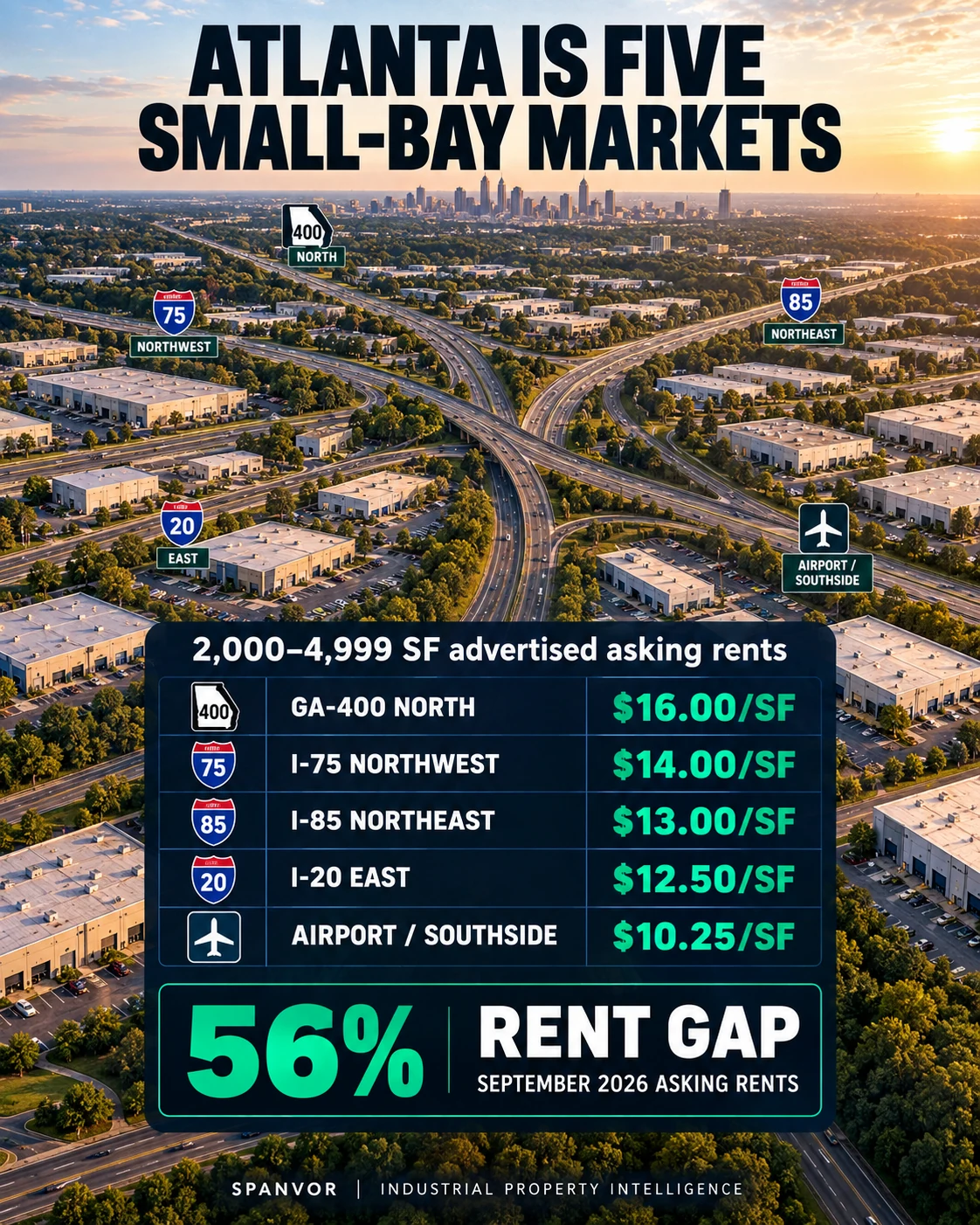
The finding, by operating corridor
I narrowed the comparison to offerings between 2,000 and 4,999 square feet. That removes the biggest source of rent-table distortion: smaller spaces normally ask more per square foot than larger ones.
| Atlanta operating corridor | Median ask | Average ask | Priced offerings | Approx. monthly base rent at 3,000 SF | |---|---:|---:|---:|---:| | North / GA-400 | $16.00/SF/year | $17.43 | 15 | $4,000 | | Northwest / I-75 | $14.00 | $14.46 | 21 | $3,500 | | Northeast / I-85 | $13.00 | $13.88 | 35 | $3,250 | | East / I-20 | $12.50 | $11.16 | 30 | $3,125 | | South / airport | $10.25 | $11.31 | 18 | $2,563 |
These are practical groupings of the named locations in the listing data, not official brokerage boundaries. They are also asking rents, not executed leases.
Still, the staircase is hard to miss.
The north / GA-400 median is about 56% above the south / airport result. The approximate difference on a 3,000-square-foot requirement is $1,438 per month, or more than $17,000 per year, before reimbursements and other occupancy costs.
Property-weighting the observations does not erase the pattern. The property-level median remains $16.00 along GA-400 and $10.78 on the southside. The gap is not simply one industrial park advertising a long list of suites.
Atlanta already tells us to think in corridors
The Atlanta Regional Commission identifies 20 freight clusters along the region's interstates and major roads. That is a better description of the industrial economy than one dot labeled Atlanta.
I-75, I-85, I-20, I-285 and GA-400 do more than move trucks through the region. They organize where contractors store equipment, where distributors reach customers, where repair businesses find affordable space, where manufacturers connect to labor and where local service companies can cover a practical territory.
The ARC freight plan estimated that freight-dependent industries represented 31% of metro Atlanta jobs in its 2020 base year. Construction accounted for more than 215,000 jobs and transportation and warehousing for more than 204,000. Manufacturing and wholesale trade added another substantial layer.
Not all of those workers occupy small-bay space. Many do not. But the categories explain why Atlanta has such a broad base of businesses that need loading, power, parking, storage, service access and a location that works before it impresses anyone.
That is the segment's demand engine.
The northeast has the choices. The north has the price.
The Northeast / I-85 corridor supplied the deepest advertised pool in the five-corridor comparison: 199 qualifying offerings across 64 marketed properties. Norcross, Peachtree Corners, Duluth, Lawrenceville, Suwanee and Buford form a long chain of established industrial and flex nodes.
Depth matters. A tenant can compare more buildings, suite configurations and operating locations without leaving the corridor. An owner also faces more visible competition.
GA-400 presents a different picture. It had fewer qualifying offerings, a smaller typical suite and the highest like-sized asking-rent baseline. Alpharetta, Cumming, Milton and the surrounding northside sit close to affluent households, fast-growing service territories and a large business base. They also contain fewer places where a noisy, practical or truck-served use fits comfortably beside higher-value development.
Scarcity is not the only possible explanation. Product age, office finish, parking, loading and power can all influence rent, and the available records do not describe those features consistently enough to hold them constant. But the high end of the map is coherent: northside geography is being offered at a premium.
Growth is coming to both ends of the rent ladder
Here is the more interesting part.
The north is not the only part of Atlanta expected to grow quickly. The Atlanta Regional Commission's county forecasts project Forsyth County to grow 79% from 2020 through 2050. Henry County, on the southside, is projected to grow 44%. Gwinnett is projected to add 24% from a much larger starting base.
Those places begin from very different small-bay rent positions today.
Cumming helped lift the GA-400 corridor to a $16 median in the controlled suite band. Stockbridge, part of the southside comparison, was closer to $10. That does not mean the southside is about to become the northside, and asking rent is not proof of demand.
It does identify a useful tension: future household and business growth is spreading through corridors whose existing rent bases are not equal.
For a developer, that raises the question of where small-business formation and rooftops may outpace the delivery of functional 2,000-to-5,000-square-foot bays. For an owner, it raises the question of whether today's lower-rent node has a tenant base that is changing faster than its building stock. For a tenant, it creates alternatives—but only if the lower-cost location still reaches customers and labor.
The lower rent is the starting point. Operating utility decides whether it is a bargain.
Atlanta's growth supports more than warehouses
The Atlanta metro reached approximately 6.48 million residents in 2025, according to the Census Bureau's latest completed metro estimates. It added nearly 62,000 residents in one year.
Looking farther out, ARC forecasts its broader 21-county planning region to add 1.8 million people and 840,000 jobs between 2020 and 2050. Manufacturing employment is projected to grow 35%. Arts, entertainment and recreation—the category that includes many training, fitness and activity businesses—is projected to grow even faster.
That matters because the small-bay tenant universe is much broader than freight and contractors.
Atlanta's bays also house automotive businesses, light manufacturers, food operators, e-commerce sellers, equipment companies, creative production users, churches, gyms, gymnastics and sports training, custom fabricators and dozens of other local operators. Some need a loading door. Some need power. Some need parking more than clear height. Many need all three.
The statewide backdrop is equally large. The Small Business Administration's 2025 profile counted 1.4 million small businesses in Georgia, representing 99.7% of the state's businesses and 1.8 million employees.
Atlanta is not short of potential occupants. The harder question is whether each corridor has the right kind of bay at a price the next business can carry.
Divisibility still earns a premium
Geography is the main story, but suite size leaves its own fingerprint.
| Advertised suite size | Median ask | Average ask | Priced offerings | |---|---:|---:|---:| | 1,000–1,999 SF | $17.77/SF/year | $17.39 | 111 | | 2,000–4,999 SF | $13.00 | $13.49 | 155 | | 5,000–9,999 SF | $11.50 | $12.57 | 81 | | 10,000–15,000 SF | $11.25 | $10.56 | 33 |
The smallest band carried a median asking rate about 58% above the 10,000-to-15,000-square-foot band.
That premium is not merely a punishment for being small. A 1,500-square-foot tenant is buying a smaller commitment, an entrance, a door, a restroom, utilities and the ability to avoid paying for space it does not need. The owner is providing more demising walls, systems and management per square foot.
The premium is the price of divisibility—and it appears in every corridor differently.
What I would watch next
Four parts of the map deserve continued attention.
GA-400: Can high asking rents hold as more product and outer-ring alternatives appear, or is functional small-bay scarcity strong enough to preserve the premium?
I-85 northeast: This is the region's deepest advertised choice pool. Repeated monthly snapshots should show which sizes and locations disappear, reprice or remain available.
The southside: Lower asking rents, airport access, major freight infrastructure and projected household growth create the most interesting “what changes next?” question in the market.
I-20 east: The corridor offers a lower price baseline, but the bay has to work. Power, parking, loading, condition and permitted use will decide whether lower rent is value or deferred cost.
Atlanta's small-bay opportunity will not be found by ranking every ZIP code from expensive to cheap. It will be found by identifying where business growth, operating access and usable supply stop lining up.
That is why the highway map matters more than the metro average.
Frequently asked questions
What was Atlanta's median advertised small-bay asking rent?
Across the qualifying 1,000-to-15,000-square-foot industrial and flex cohort, the median advertised asking rent was $13.50/SF/year and the average was $14.18.
Which Atlanta corridor had the highest like-sized asking rent?
The North / GA-400 corridor had the highest median at $16.00/SF/year for 2,000-to-4,999-square-foot offerings. The south / airport corridor had the lowest of the five published comparisons at $10.25.
Are these signed lease rates?
No. They are publicly advertised asking rents as of September 3, 2026. Executed and effective rents may differ after negotiation, concessions and tenant improvements.
Is the southside's lower rent proof that it is undervalued?
No. The spread may reflect building age, suite condition, tenant mix, office finish, power, loading, parking, lease structure and location. The southside is interesting because it combines a lower starting rent with freight access and projected population growth—not because one snapshot proves mispricing.
Why use corridors instead of city averages?
Many Atlanta industrial users make location decisions around interstate access, service territories, customers and employee travel. Corridor groupings better reflect those operating choices than one metro number, while still requiring property-level diligence.
How we counted
SpanVor reviewed publicly advertised industrial and flex offerings collected through September 3, 2026 across the broader Atlanta-area search footprint. The publishable cohort contains 804 suite-level offerings across 308 marketed property addresses, each between 1,000 and 15,000 square feet and identified for industrial, warehouse, manufacturing, distribution, showroom, storage or flex use. Pure office, pure retail and land records were removed. 380 offerings published a usable annual asking rent.
The corridor comparison uses only offerings between 2,000 and 4,999 square feet to reduce suite-size distortion. Averages and property-weighted medians were used as cross-checks. Corridor labels are analytical groupings, not official submarket definitions. Offering counts are not vacancy, absorption or a complete census of all available space, and advertised suite square footage can include combinable configurations.
Key takeaways
- Atlanta's small-bay rent market follows its operating corridors more closely than one metro average.
- In the controlled 2,000-to-4,999-square-foot cohort, the median ask ranged from $16.00/SF/year along GA-400 to $10.25 south of the airport.
- The Northeast / I-85 corridor had the deepest advertised choice pool among the five corridor groups.
- ARC identifies 20 freight clusters in metro Atlanta, reinforcing the idea that industrial demand is distributed along the transportation network.
- Forsyth and Henry counties are both projected to grow quickly, but they begin from very different asking-rent baselines.
- The smallest suites carried a 58% median premium over 10,000-to-15,000-square-foot offerings.
Explore the public Atlanta market profile and compare the national Industrial Property Statistics and Industrial Development Pipeline.
SpanVor tracks industrial properties, advertised space and development activity across the United States. You can explore the property-level platform with 14 days of SpanVor All-Access—no credit card—at spanvor.com/trial.
One last thing, since you read this far: the code SpanvorBlog takes 25% off a SpanVor Pro subscription—where the property-level data behind posts like this one lives.
Written by Jason Probert, Founder of SpanVor—Industrial Property Intelligence.