South Florida's small-bay asking-rent map has a barbell shape. For publicly marketed 2,000-to-4,999-square-foot industrial and flex space, the median was $26.25/SF/year in Palm Beach County, $25.00 in Miami-Dade and $19.97 in Broward.
On a 3,000-square-foot bay, that works out to approximately $6,563, $6,250 and $4,993 per month, respectively, before operating expenses, utilities, concessions or improvements.
The unsurprising part is that Miami costs a lot. The surprising part is that Palm Beach costs slightly more—and Broward, sitting between them, looks like South Florida's small-bay value corridor.
That does not make Broward cheap. It makes “South Florida rent” a nearly useless answer to the question a tenant, owner or broker is actually asking.
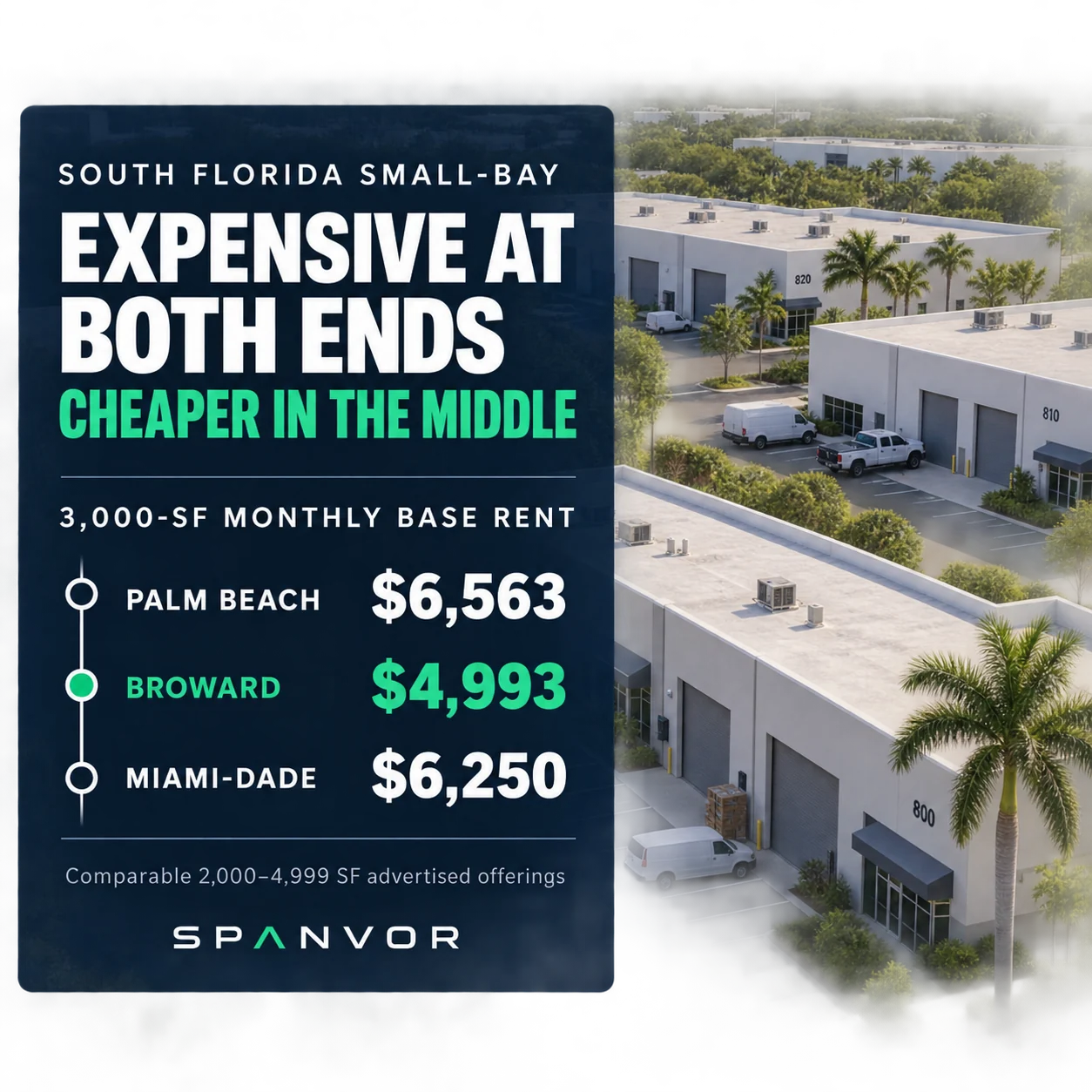
One metro. Three different checks.
The Miami–Fort Lauderdale–West Palm Beach metro contains about 6.39 million people, according to the Census Bureau's 2025 estimate. On paper, it is one metropolitan economy. On the road, it is a long chain of operating locations bounded by the Atlantic on one side and the Everglades on the other.
SpanVor's August listing review makes that geography visible.
| County | Median ask, 2,000–4,999 SF | Average ask | Priced offerings | Approx. monthly base rent at 3,000 SF | |---|---:|---:|---:|---:| | Palm Beach | $26.25/SF/year | $25.29 | 74 | $6,563 | | Miami-Dade | $25.00 | $26.30 | 84 | $6,250 | | Broward | $19.97 | $21.13 | 121 | $4,993 |
The Palm Beach median is about 31% above Broward. Miami-Dade is about 25% higher. The averages point in the same direction, so the finding is not being carried by one odd midpoint.
For a tenant, the gap is roughly $1,250 to $1,570 per month in advertised base rent on a 3,000-square-foot requirement. That can pay for a vehicle, equipment, insurance or part of another employee.
For an owner, it is a warning against using a metro average as “market rent.” And for a broker, it is the beginning of the conversation: what does the higher-priced location give the tenant that Broward does not?
Broward is not the weak middle
The word “discount” can imply weaker demand. I do not think that is the right read here.
Broward sits near the geographic center of a six-million-person region. Port Everglades handled a record 1,167,552 twenty-foot equivalent units (TEUs) in fiscal 2025, and the port is connected to I-595, I-95, Florida's Turnpike and a near-dock rail facility (Port Everglades). Broward County's own research counted 58,510 small businesses employing more than 356,000 people in its latest detailed firm-size study (Broward County).
This is not a market lacking reasons for businesses to operate there.
It may simply offer more ways to do so. Broward supplied 317 qualifying offerings in our reviewed 1,000-to-15,000-square-foot cohort, compared with 233 in Miami-Dade and 180 in Palm Beach. More choices do not automatically create lower rents, but a deeper advertised pool gives tenants more alternatives and makes it harder for one premium node to define the county.
The city results show that range:
| Broward node | Median ask, 2,000–4,999 SF | Priced offerings | 3,000-SF monthly illustration | |---|---:|---:|---:| | Pompano Beach | $21.95/SF/year | 23 | $5,488 | | Fort Lauderdale | $19.97 | 29 | $4,993 | | Sunrise | $16.50 | 10 | $4,125 |
A business can remain inside Broward and still see a difference of more than $1,300 per month between the Pompano Beach and Sunrise medians.
The lower rate only matters if the bay works. Power, loading, office finish, parking, yard, access and employee travel can erase a nominal discount quickly. But Broward deserves to be viewed as a set of practical alternatives—not as the space between Miami and Palm Beach.
Miami-Dade's premium has an operating reason
Miami-Dade's small-bay premium is easier to understand when you look at what moves through the county.
Miami International Airport handled a record 3.4 million tons of freight in 2025, 85% of it international, and ranked first among U.S. airports for total freight (MIA). PortMiami handled 1,115,058 TEUs in fiscal 2025, its eleventh straight year above one million (PortMiami).
Those gateways create a dense web of distributors, freight forwarders, repair companies, food users, equipment businesses and local service providers. They do not all need giant warehouses. Many need a few thousand square feet close to the airport, the port, customers and labor.
That is why Doral matters. In the controlled 2,000-to-4,999-square-foot band, its median advertised ask was $27.43/SF/year across 12 priced offerings—about $6,858 per month for a 3,000-square-foot illustration. Miami proper was $25.00 across 51.
The premium is not proof that every Doral bay earns its price. It is evidence that airport access and established industrial geography are being offered at a high number.
The land itself reinforces the pressure. Miami-Dade's planning documents describe how the ocean, Everglades, aquifer and Urban Development Boundary constrain developable land (Miami-Dade County). In a place where households, logistics and small businesses all compete for limited functional land, a properly zoned industrial bay carries option value that a generic rent table misses.
Palm Beach is the more interesting surprise
Palm Beach posted the highest county median in the comparable small-suite band even though the broader industrial market has softened.
CBRE's Q2 2026 report put countywide industrial vacancy at 8.0% following a substantial delivery cycle, with 799,000 square feet still under construction. Yet SpanVor's smaller advertised offerings remained expensive: West Palm Beach had a $27.25 median for 2,000-to-4,999-square-foot space, while Boca Raton was $25.75.
There is no contradiction. A newly delivered 100,000-square-foot building and a 3,000-square-foot bay do not solve the same problem.
Palm Beach's result may reflect smaller marketed suites, newer or better-finished product, affluent service territories, limited functional inventory in particular nodes, or a combination of those factors. The current snapshot cannot cleanly assign the premium among them.
What it can say is more useful: headline industrial availability is not a substitute for suite-level choice. A market can have more empty square footage and still be expensive for the business that needs one small, functional bay in the right place.
South Florida also charges for divisibility
Location is only half the price map. Suite size matters throughout the region.
| Advertised suite size | Median ask | Average ask | Priced offerings | |---|---:|---:|---:| | 1,000–1,999 SF | $24.00/SF/year | $24.79 | 197 | | 2,000–4,999 SF | $22.94 | $23.79 | 279 | | 5,000–9,999 SF | $21.00 | $22.41 | 101 | | 10,000–15,000 SF | $19.50 | $20.47 | 22 |
The smallest band carried a median rate about 23% above the 10,000-to-15,000-square-foot band.
That is not irrational. A tenant pays more per foot for a smaller commitment, an individual entrance, a usable door, existing office, separate utilities and the ability to avoid leasing space it does not need. The landlord has more doors, meters, restrooms, turnovers and management work per square foot.
Nearly 78% of the advertised choices in our qualifying cohort were below 5,000 square feet, but those offerings represented only 52% of the marketed square footage. That is the defining arithmetic of small-bay: a large number of business decisions packed into a comparatively modest amount of space.
The advertised rate is not the occupancy cost
The monthly figures above are base-rent illustrations, not all-in checks.
Only 200 of the 599 priced offerings in the reviewed cohort stated a lease structure. Of those, 120 were triple net, 77 were modified gross and three were full-service gross. A $22 asking rate under one structure may cost the tenant more than a $24 rate under another once taxes, insurance, maintenance and utilities are added.
South Florida makes that distinction especially important. A tenant should compare the monthly obligation, not merely the rate in bold type. An owner should know whether a competing property's apparent discount is real or simply excludes more expenses.
The second-level read
South Florida is not one small-bay market. It is a chain of operating nodes with different access, tenant pools, building stock and pricing.
Miami-Dade offers unmatched international freight connectivity and charges for it. Palm Beach's small-suite market remains expensive even while broader industrial vacancy has risen. Broward combines central geography, a major port and the deepest advertised choice pool with a lower asking-rent baseline.
The investment question is not “which county is cheapest?” It is whether a property's location and functionality earn the rent tenants are being asked to pay.
The tenant question is the mirror image: does the expensive node produce enough operating value to justify the check?
That is the real South Florida comp set.
Frequently asked
What was the median South Florida small-bay asking rent?
Across SpanVor's qualifying 1,000-to-15,000-square-foot cohort, the median advertised asking rent was $23.00/SF/year and the average was $23.76. Rates differed materially by county, submarket and suite size.
Which county was most expensive for a 2,000-to-4,999-square-foot offering?
Palm Beach County had the highest median at $26.25/SF/year, followed by Miami-Dade at $25.00 and Broward at $19.97.
Does Broward's lower asking rent mean it is a weaker industrial market?
No. Broward has central regional access, Port Everglades and a large small-business economy. Its lower median may reflect a deeper choice pool, different building stock and submarket mix. Asking-rent data alone cannot assign the cause.
Are these signed lease rates?
No. They are publicly advertised asking rents as of August 31, 2026. Executed and effective rents may differ after negotiations, concessions and improvements.
Do the monthly figures include operating expenses?
No. They are simple annual base-rent illustrations divided by twelve. Taxes, insurance, maintenance, utilities and other expenses depend on the lease structure and property.
How we counted
SpanVor reviewed publicly advertised industrial and flex offerings collected through August 31, 2026 across Miami-Dade, Broward and Palm Beach counties. The publishable cohort contains 730 offerings across 463 marketed properties, each between 1,000 and 15,000 square feet and identified as industrial, warehouse, manufacturing, distribution, showroom or flex use. We removed office-only, retail-only and land records, out-of-market observations and implausible rent entries. 599 offerings published a usable annual asking rent.
County and submarket comparisons use only offerings between 2,000 and 4,999 square feet to reduce the distortion caused by different suite-size mixes. Medians show the midpoint; averages are provided as a second check. Offering counts are not vacancy, absorption or a complete census of all available space.
Key takeaways
- South Florida's small-bay asking-rent map is expensive at both ends and materially lower in Broward.
- For comparable 2,000-to-4,999-square-foot offerings, Palm Beach and Miami-Dade medians were about 31% and 25% above Broward.
- Broward had the region's deepest advertised choice pool and a lower asking-rent baseline despite its central location and major freight infrastructure.
- Smaller bays command a clear divisibility premium: the under-2,000-square-foot median was about 23% above the 10,000-to-15,000-square-foot band.
- Base rent is not occupancy cost; lease structure and building functionality still decide whether an apparent discount is real.
Read the broader Florida four-market comparison, explore the public Miami–Fort Lauderdale market profile, and compare the Florida Industrial Data Atlas.
SpanVor tracks industrial properties, advertised space and development activity across the United States. You can explore the property-level platform with 14 days of SpanVor All-Access—no credit card—at spanvor.com/trial.
One last thing, since you read this far: the code SpanvorBlog takes 25% off a SpanVor Pro subscription—where the property-level data behind posts like this one lives.
Written by Jason Probert, Founder of SpanVor—Industrial Property Intelligence.