Not every startup needs four walls. But a surprisingly large share of new business formation starts in categories where a laptop, a spare bedroom, or a storefront is eventually not enough.
That is the useful way to read the business-formation story.
The lazy version is to see 5.7 million U.S. business applications and call them future tenants. They are not. An application is not even necessarily a business yet, much less a signed lease.
The more interesting version is to ask what those businesses are trying to do. Are they carrying tools? Making something? Receiving inventory? Parking vehicles? Teaching classes? Serving customers? Storing equipment? The answers point toward very different kinds of real estate.
Small bay sits in the middle of that exercise. It is not the automatic destination for every new business. It is the practical operating format for a lot of businesses once the garage, spare room, borrowed yard, or improvised back office stops working.
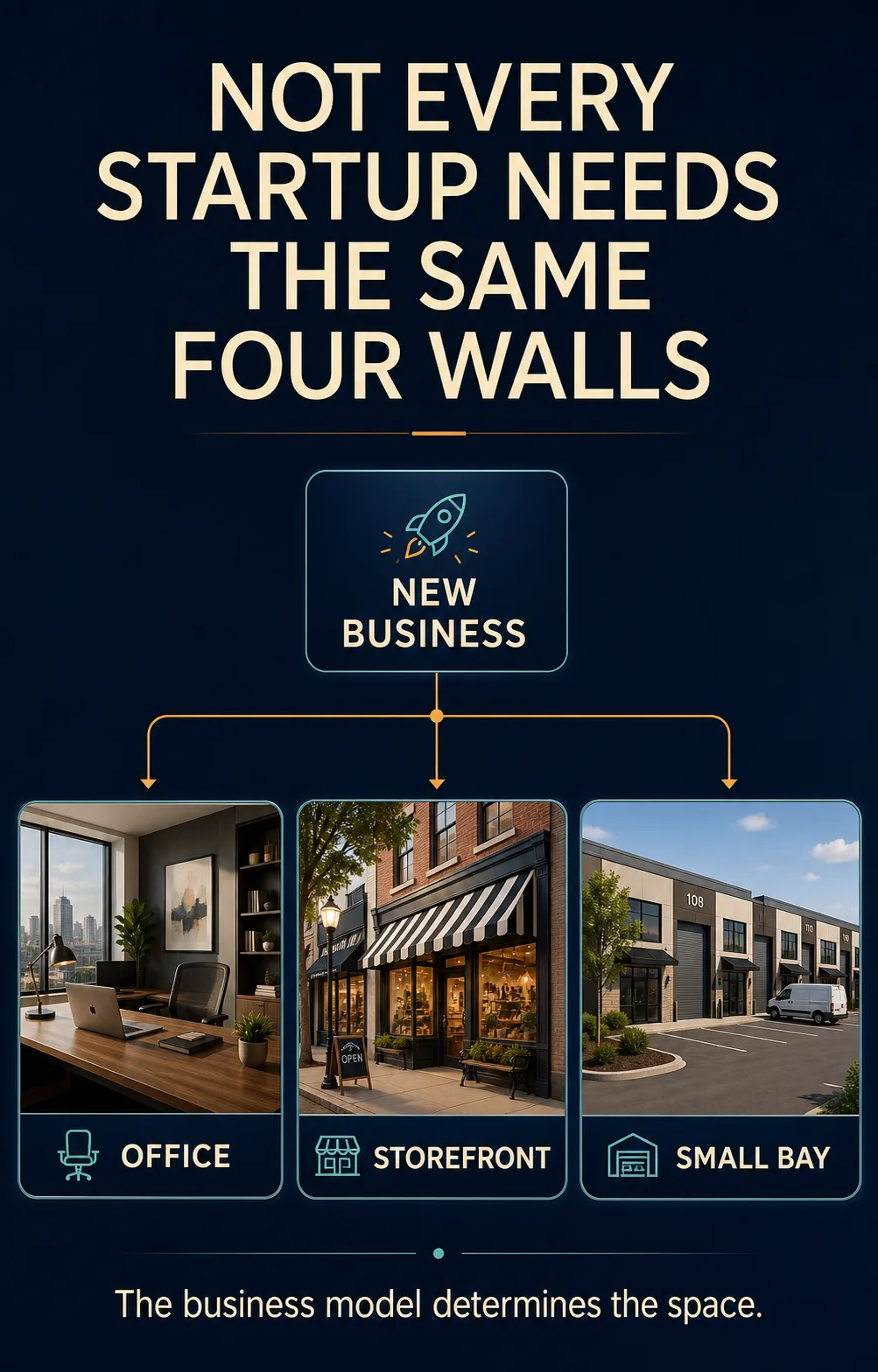
What do we mean by a potential small-bay user?
A potential small-bay user is not a tenant count. It is a business type whose operating pattern can plausibly call for functional, local space: a door, parking, room for equipment or inventory, power, customer access, and a place to actually run the business.
That puts a construction company in a different bucket from a solo consultant, even if both filed an EIN application in the same week. It also puts a cabinet maker in a different bucket from a restaurant, a gym, or a law firm—even though all four can show up in a small-bay park under the right circumstances.
The point is not to say who will rent. The point is to separate categories that naturally create operating-space questions from categories that usually lead somewhere else.
The finding, in five years of formation
The U.S. Census Bureau recorded 5.67 million business applications in 2025, the highest annual total in this five-year view. The total is big. The mix is more useful.
| U.S. business applications | 2021 | 2022 | 2023 | 2024 | 2025 | | --- | ---: | ---: | ---: | ---: | ---: | | All applications | 5.39M | 5.06M | 5.47M | 5.22M | 5.67M | | Construction | 499K | 496K | 546K | 522K | 519K | | Manufacturing | 95K | 89K | 95K | 96K | 84K | | Wholesale trade | 135K | 118K | 127K | 125K | 115K | | Transportation & warehousing | 477K | 428K | 393K | 351K | 367K |
Source: U.S. Census Bureau Business Formation Statistics. Annual figures sum unadjusted monthly U.S. business applications. Applications are not lease counts or business births.
Construction, manufacturing, and wholesale trade alone accounted for about 718,000 applications in 2025. Those are not three perfect small-bay categories. A manufacturer can need a much bigger plant. A wholesaler can need a large distribution building. A construction business can stay in a truck and a yard for years.
But they are three categories where the underlying work often creates a physical-space decision. Tools, materials, inventory, loading, assembly, vehicles, dispatch, and delivery all have a way of outgrowing the kitchen table.
Transportation and warehousing adds another 367,000 applications. I would put that in the “possible” column, not the “likely” column. The label includes local operators that need fleet parking, storage, or a modest dispatch location. It also includes businesses that do not need a bay at all. That distinction matters.
Which new businesses are the clearest bay candidates?
The strongest category fit is not glamorous. It is operational.
| Formation family | 2025 applications | Small-bay lens | Why it may need a bay | | --- | ---: | --- | --- | | Construction | 519K | Likely | Tools, materials, vehicles, dispatch, doors, and storage. | | Manufacturing | 84K | Likely | Production, assembly, power, loading, and delivery. | | Wholesale trade | 115K | Likely | Inventory, receiving, and local distribution. | | Transportation & warehousing | 367K | Possible | Fleet, handling, and storage for some; another format or no building for others. | | Repair and maintenance | about 114K | Possible | Equipment, parts, work area, parking, and roll-up doors can matter. | | Education + recreation | about 250K | Possible | Training, gymnastics, martial arts, baseball, studios, and other activity-led uses can fit the right park. | | Administrative/support + waste | 377K | Possible | Some operators have field crews or equipment; many do not. |
The table is a map of operating logic, not a conversion model. It is deliberately not totaled into a national “small-bay renter” figure.
That restraint is useful. If we added every mixed category because we can think of one small-bay example, the number would be too big to mean anything. If we counted only construction, manufacturing, and wholesale, the story would be too narrow to describe how these parks actually work.
The real tenant universe is broader: HVAC technicians, fabricators, cabinet shops, equipment repair, specialty distributors, local manufacturers, courier operations, fitness concepts, gymnastics programs, baseball academies, martial-arts studios, churches, caterers, custom-car operators, and plenty of businesses that do not fit neatly into a broker’s old category list.
Why are repair, recreation, and training in the “possible” column?
Because the building does not care what the spreadsheet calls the tenant. It cares what the tenant needs to do on Tuesday afternoon.
The Census’s more detailed industry file recorded about 114,000 2025 applications in Repair and Maintenance. That is a classic example of a category where work area, equipment, parts storage, doors, power, parking, and customer flow can make a bay genuinely useful.
Recreation and training is less tidy. Education plus arts, entertainment, and recreation produced about 250,000 applications in 2025. Some will lead to schools, studios, theaters, or home-based activity. Others may be exactly the gymnastics, cheerleading, CrossFit, baseball-training, yoga, or martial-arts operators that make a well-located small-bay park feel more like a local business district than an industrial statistic.
I would not underwrite that entire category as industrial demand. I would be equally reluctant to pretend it does not exist because it makes the tenant story less traditional.
Which new businesses usually need another format?
This is where the small-bay story can get too enthusiastic.
Professional services generated about 764,000 applications in 2025, and retail generated about 1.17 million. Most of those businesses are more likely to need office, storefront, remote, or no dedicated commercial space at all. The fact that a lawyer can use a flex office, or an e-commerce seller can grow into a bay, does not turn either headline category into a small-bay forecast.
Food service is similar. Census counted about 300,000 applications in Food Services and Drinking Places in 2025. A caterer or production-kitchen operator may be a real small-bay user; the broader sector also includes restaurants and bars that plainly need something else. The public data do not isolate the caterer count, so we should not make one up.
Personal and laundry services are mostly a storefront/service story. Religious and civic organizations are mixed too: some churches use flex space beautifully; many organizations do not need a bay. The right answer is not to exclude the exceptions. It is to call them exceptions until better operating detail is available.
What does this change for an owner or investor?
It changes the question from “is industrial demand growing?” to “what kinds of local businesses are being created around this asset, and can this property serve them?”
That is a much better question.
A functional 6,000-square-foot suite with parking, a usable door, the right power, sensible access, and an approvable use can serve a different part of the business-formation economy than a generic vacancy number suggests. A poorly configured bay with no parking, no usable loading, weak power, or a bad site can miss the same demand entirely.
The national numbers get your attention. The local business mix, suite configuration, site functionality, and competing supply decide whether the demand reservoir reaches a particular property.
What comes next in this series?
This is the second article in SpanVor’s ongoing look at the businesses behind small-bay demand.
Next, we will turn the category map into a more practical guide: what kinds of space different operators often start with, what drives those ranges, and why square footage alone does not describe the decision. When the new-small-bay supply work is ready, we will put a transparent demand range beside actual product entering the market. Then the real work begins: the market-by-market versions, starting with DFW and Atlanta where the coverage can support a useful answer.
Frequently asked questions
Do business applications equal small-bay tenants?
No. An EIN application is an early formation indicator. Many applications will not become employer businesses, and many operating businesses will not need industrial space. The category map identifies potential fit, not future leases.
Why not publish one national potential-demand number?
Because the public categories do not tell us which applications will lease, how much space they will need, when they will need it, or whether a local market has an appropriate suite. A single conversion rate would look precise and be mostly invented.
Can a law firm, church, gym, or e-commerce seller use small bay?
Yes. Individual businesses can use a format that is not typical for their broad Census sector. The map is meant to guide the first question, not overrule the specific site, use, and operating requirements.
Method and source note
The category counts use U.S. Census Bureau Business Formation Statistics. The five-year sector table sums the 12 unadjusted monthly U.S. Business Applications observations for each year, 2021 through 2025. Census makes the national monthly series available by broad NAICS sector. Repair and Maintenance is shown from the separate, rounded weekly 3-digit NAICS file because it is not broken out in the monthly 2-digit series; it is not combined into a national total with the monthly sectors.
The “likely,” “possible,” and “usually another format” labels are SpanVor’s operating-space judgment, based on what the underlying business typically needs to do. They are not a Census classification, zoning opinion, occupancy dataset, or lease forecast.
Key takeaways
- America formed 5.67 million business applications in 2025; the mix matters more to small bay than the headline total alone.
- Construction, manufacturing, and wholesale produced about 718,000 2025 applications in categories with clear operating-space needs.
- Transportation, repair, recreation, training, food production, churches, and other local operators widen the tenant universe—but should be treated as mixed, use-specific categories.
- A category is not a lease. The local business mix, suite functionality, site constraints, and competing supply decide whether formation activity becomes real occupancy.
- The next useful work is practical: which operators need what kind of space, then how that potential demand compares with actual new small-bay supply.
For the wider case for small bay, read the Small-Bay Industrial Investor Primer. For the property-level questions that separate usable space from nominal space, start with the Small-Bay Asset Passport and Vacancy Is Measured in Square Feet. Tenants Shop in Suites.
SpanVor is building a clearer way to see the property, suite, site, business, and market details that turn a formation trend into an occupancy question. You can explore public market context now, then unlock property-level precision with Pro.
One last thing, since you read this far: the code SpanvorBlog takes 25% off a SpanVor Pro subscription—where the parcel-level data behind posts like this one actually lives.
Written by Jason Probert, Founder of SpanVor.