The most important small-bay demand driver may not be e-commerce, reshoring, or the next industrial headline. It may be the far more ordinary decision to start a business.
Not every new business will rent a bay. Some will stay home, live online, occupy an office, or never make it past the first year. But the ones that need a place to park vans, receive materials, make things, teach classes, store equipment, meet customers, and run an operation are the businesses that fill small-bay industrial. The reservoir behind them got much larger after 2020—and, importantly, it has stayed larger.
That is the part of the small-bay thesis that deserves more attention.
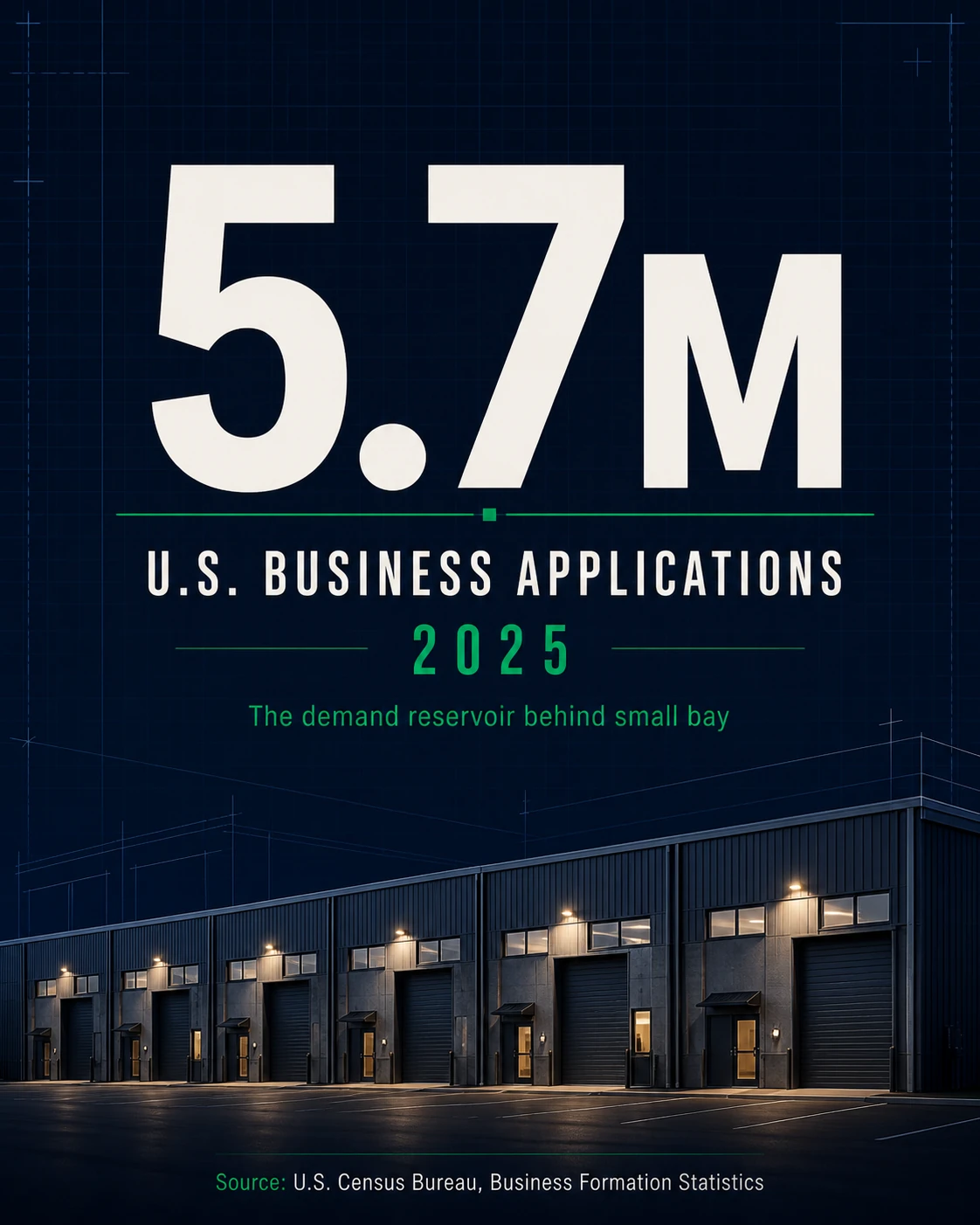
The finding, in three numbers
The Census Bureau recorded 5.67 million U.S. business applications in 2025. That compares with 3.50 million in 2019.
The surge did not simply spike in the first year of COVID and disappear. Annual applications ran from 5.06 million to 5.67 million in every year from 2021 through 2025.
There were also 1.71 million high-propensity applications in 2025—Census's narrower category for applications with characteristics associated with a greater likelihood of becoming an employer business. And construction alone accounted for about 519,000 applications, roughly 36% above 2019.
| U.S. business formation indicator | 2019 | 2021 | 2025 | | --- | ---: | ---: | ---: | | Business applications | 3.50M | 5.39M | 5.67M | | High-propensity applications | 1.32M | 1.84M | 1.71M | | Construction applications | 382K | 499K | 519K |
Source: U.S. Census Bureau Business Formation Statistics. Annual figures are the sum of unadjusted monthly U.S. applications; Census revises the series periodically.
Why does starting a business matter to small-bay occupancy?
Because small bay is, at its core, working infrastructure for local enterprise.
The first version of a business may be a truck, a garage, a spare bedroom, or a borrowed corner of someone else's shop. The next version often needs a front door of its own.
That move is not limited to the familiar contractor story. An HVAC firm may need fleet parking and shelving; a fabricator needs power and a roll-up door; a gymnastics program needs clear height and customer parking. A custom-car operator, church, law firm, studio, medical supplier, caterer, yoga business, or baseball training program may each need a different version of the same thing: functional, affordable space close to people and customers.
That is why small bay has hundreds of possible users. It is not a smaller version of a giant warehouse. It is the physical operating layer underneath local business formation.
The Census data cannot tell us which applicant will lease a 5,000-square-foot suite. It does tell us that the pool of people attempting to build businesses has remained far larger than it was before the pandemic. For a property type whose tenant base is composed of local businesses rather than a few national tenants, that is not a small backdrop.
What does the post-2020 formation plateau really say?
The obvious read is that the pandemic created an unusual entrepreneurship spike. That is true.
The more useful read is that the spike did not fall back to the old level. U.S. applications were 3.50 million in 2019. They exceeded five million in each of the last five completed years in the Census series.
That does not make every one of those applications durable. It does not make every founder creditworthy. And it certainly does not turn a national application count into a local rent forecast.
It creates a deeper bench of potential occupiers, vendors, service providers, and future tenants. In a growing suburb or older service corridor, the effect can compound: one new business often creates work for another business that needs tools, storage, equipment, deliveries, or a customer-facing operating location.
The better question is: what is replenishing the local pool of businesses that could need the next bay?
Why does limited new shallow-bay supply make that more interesting?
Demand matters most when it is meeting something difficult to replace.
CBRE's March 2026 research is useful here, with one important scope note. It examines shallow-bay properties—buildings under 50,000 square feet with relatively modest clear heights—in major U.S. markets. That is narrower than every kind of small-bay industrial. Still, it puts a number on a condition operators have long understood: more than 80% of the studied inventory was built before 2000, while properties built since 2010 account for only 5%.
The replacement pipeline has been thin because the product is harder to build than it looks. A small-bay park needs more doors, panels, parking decisions, tenant improvements, leasing work, and management per square foot—and wants land near the local customers and labor that make the tenant base work. Those are not the sites where development is cheapest or easiest.
Big-box logistics got most of the industrial development cycle because a 500,000-square-foot building is a cleaner capital-allocation exercise. That made the existing, functional small-bay stock harder to replace.
Put those two conditions together—a larger formation reservoir and a limited replacement pipeline—and the long-run odds favor well-located, functional small-bay assets. Not every asset. Not every market. But the basic imbalance is worth underwriting.
What should an investor actually watch?
Business formation is a starting signal, not a buy signal.
I would want to see it alongside five more practical questions:
- Which businesses are forming locally? Construction, repair, manufacturing, wholesale, transportation, recreation, and specialized local businesses do not have the same space needs.
- Where are they operating? The useful geography is rarely a whole metro. It is the service corridor, trade area, or infill neighborhood the business can actually reach every day.
- What kind of suite does the market offer? Building square footage is not suite supply. The real question is whether the market has functional 3,000-, 8,000-, or 15,000-square-foot choices with the right doors, power, parking, access, and approved use.
- What is being built nearby? A broad industrial pipeline can be mostly irrelevant big-box product—or it can include a new multi-tenant park two miles away. Those are different underwriting outcomes.
- Is the asset usable for the next business, not just the current one? A low-rent tenant in a constrained, underpowered bay can still be a poor setup for the next lease.
The national formation trend gets your attention. The local tenant, suite, and site facts decide whether it belongs in an investment memo.
Where could this thesis be wrong?
The biggest risk is overgeneralization.
Business applications are not business births, and business births are not leases. A soft local economy, weak site functionality, poor parking, bad access, an obsolete layout, or too much competing small-bay product can overwhelm a favorable national backdrop.
The conclusion is not “buy anything with roll-up doors.” It is more useful: the demand side for functional, local-business infrastructure is deeper than the usual industrial narrative suggests, and it belongs next to the supply analysis in every small-bay underwriting.
Frequently asked questions
Do business applications equal future small-bay tenants?
No. Census business applications include many firms that will never rent industrial space, and some will not become operating employer businesses. They are a leading indicator of entrepreneurial activity—not a count of future leases.
Is every small-bay market supply constrained?
No. A market can have constrained older infill supply and still deliver a competing new park in the wrong place at the wrong time. Supply must be checked locally and at the suite level.
This is the first of a larger series
This is the opening article in an ongoing SpanVor series about the businesses behind small-bay demand.
Next, we will break down new business formation by category and ask a more useful question than “how many businesses are starting?”: which kinds of businesses are likely to need working space, and what kind of space might they need? That means practical space ranges and operating requirements—not just a generic square-footage number—for the contractor, maker, specialty distributor, e-commerce operator, training program, gym, custom-car shop, and the many other businesses that use small bay differently.
As the new small-bay supply work is completed, we will also put the two sides beside one another: a transparent range for potential demand from new business formation and the actual local product entering the market. That is where this national story becomes a series of market stories—starting with DFW and Atlanta, then expanding city by city where the coverage supports a useful answer.
The goal is not to make a national application count sound more precise than it is. It is to give owners, brokers, investors, and operators a better way to see where the next generation of small-bay demand may come from.
Method and source note
Business-application figures are from the U.S. Census Bureau's Business Formation Statistics, downloaded August 7, 2026. Annual totals sum the unadjusted monthly U.S. series, which Census periodically revises. The CBRE source defines shallow bay more narrowly than small bay: buildings under 50,000 square feet with 14- to 28-foot clear heights in major U.S. markets.
Key takeaways
- U.S. business formation activity has remained materially above its pre-pandemic level, with 5.67 million applications in 2025.
- The number is not a tenant count, but it is a meaningful demand reservoir for a property type occupied by local businesses.
- Construction applications remained about 36% above 2019 in 2025, one useful indicator of the operating-business base that often uses small bay.
- CBRE's shallow-bay research shows a deeply mature supply base: more than 80% of its studied inventory predates 2000, with only 5% built since 2010.
- The investable question is local: which businesses are forming, which suites can they use, and what genuinely comparable supply is coming behind them?
For the wider case for small bay, read the Small-Bay Industrial Investor Primer. For the physical questions that make a suite useful, start with the Small-Bay Asset Passport and Vacancy Is Measured in Square Feet. Tenants Shop in Suites.
SpanVor is building a clearer view of the property, building, site, business, and market details that decide whether local demand can become real occupancy. You can explore public market context now, then unlock property-level precision with Pro.
One last thing, since you read this far: the code SpanvorBlog takes 25% off a SpanVor Pro subscription—where the parcel-level data behind posts like this one actually lives.
Written by Jason Probert, Founder of SpanVor.