If you showed me only a map of where metro Phoenix is investing for its next decade, I would expect the small-bay leasing market to be thickest on the north and west sides.
That is where the region is extending infrastructure, adding housing and assembling one of the largest advanced-manufacturing ecosystems in the country.
But that is not where most of the small industrial choices in our September snapshot appeared.
SpanVor reviewed just over 500 publicly advertised industrial and flex offerings between 1,000 and 15,000 square feet across the Phoenix metropolitan area. Together they represented approximately 2.2 million square feet across about 200 property addresses.
The most interesting finding was not the metro-wide rent. It was the geography.
Nearly 300 offerings were concentrated in the core East Valley cities of Tempe, Mesa, Chandler, Gilbert and Scottsdale. The major West Valley cities in our cohort—Glendale, Peoria, Avondale, Goodyear, Tolleson, Surprise, Litchfield Park and Buckeye—produced only about 40.
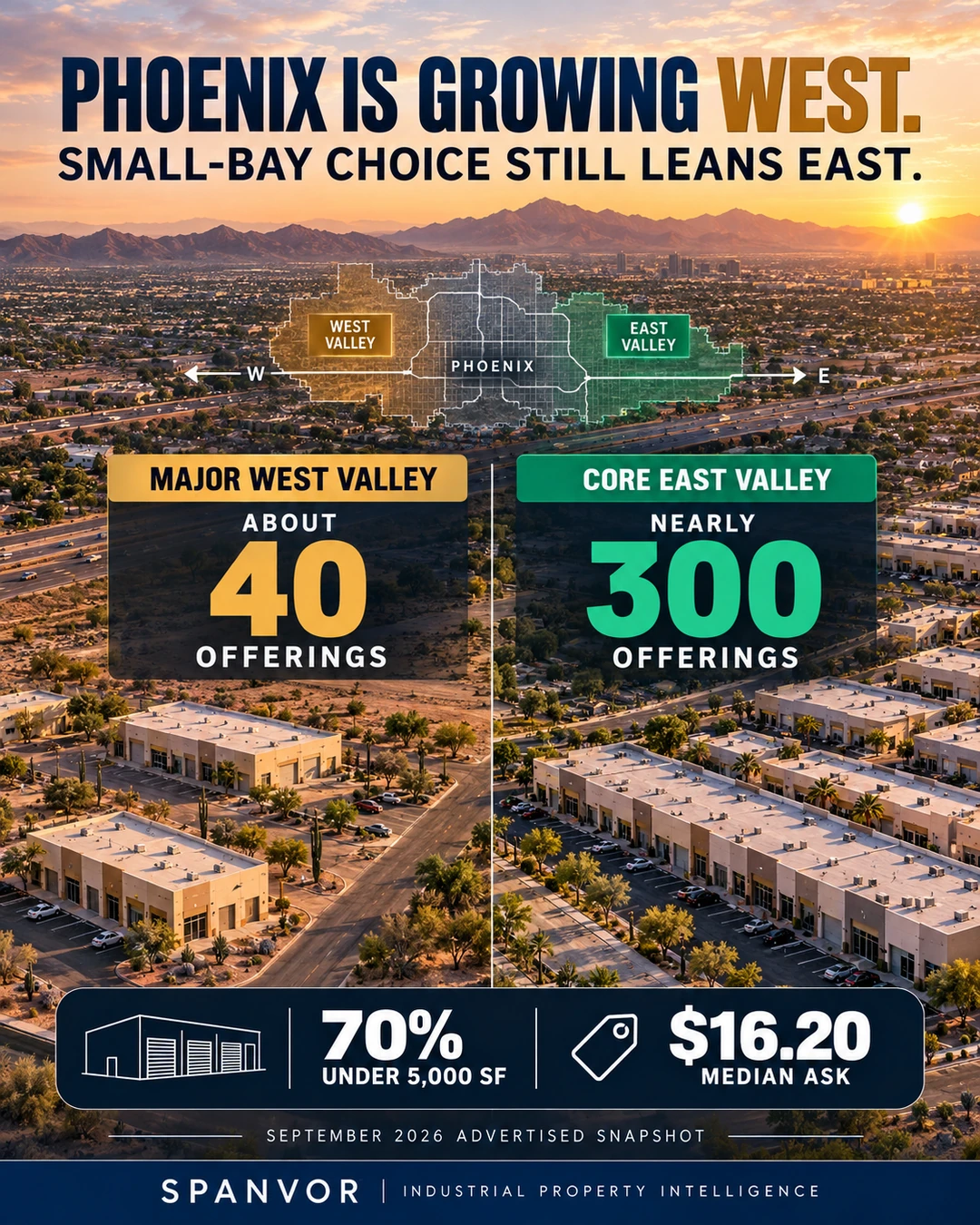
This is not proof that the West Valley has no small-bay inventory, nor is advertised availability the same thing as vacancy. It is a snapshot of the choices a tenant could readily find and compare in early September.
Still, the imbalance is difficult to ignore.
The Phoenix snapshot
| Measure | September 2026 snapshot | |---|---:| | Qualifying advertised offerings | Just over 500 | | Property addresses represented | About 200 | | Advertised suite area | About 2.2 million SF | | Offerings below 5,000 SF | 70% | | Offerings publishing an asking rent | About 80% | | Median asking rent | $16.20/SF/year | | Average asking rent | $16.76/SF/year |
The median available suite was approximately 3,100 square feet. That is an important clue about what this market really is. Phoenix may be known nationally for giant distribution centers, semiconductor fabs and acres of new development, but the space visible to a local contractor, fabricator, service company or equipment supplier is still frequently measured one bay at a time.
Phoenix does not have a clean small-suite rent curve
In many markets, the smallest bays carry the highest asking rent and the rent falls steadily as the commitment grows.
Phoenix did not cooperate with that simple story.
| Advertised suite size | Offerings | Median asking rent | Average asking rent | |---|---:|---:|---:| | 1,000–1,999 SF | 170 | $17.40 | $17.34 | | 2,000–4,999 SF | 194 | $15.90 | $16.55 | | 5,000–9,999 SF | 119 | $17.40 | $16.89 | | 10,000–15,000 SF | 37 | $13.68 | $14.47 |
The premium below 2,000 square feet is familiar. The surprise is the 5,000-to-9,999-square-foot band, where the median returned to $17.40.
I do not read that as evidence that 7,000 square feet is inherently more valuable than 3,000 square feet. I read it as evidence that suite size is not doing the pricing by itself.
Much of the larger-bay priced sample sits in East Valley locations and in product with a different combination of age, finish, loading, visibility and permitted use. In Phoenix, a rent table that ignores geography and functionality can create more confusion than clarity.
A 3,000-square-foot bay changes price as it crosses the Valley
To reduce the effect of suite-size mix, I compared advertised rents only within the 2,000-to-4,999-square-foot band.
| City | Priced offerings | Property addresses | Median asking rent | Approx. monthly base rent for 3,000 SF* | |---|---:|---:|---:|---:| | Scottsdale | 12 | 7 | $20.00 | $5,000 | | Tempe | 36 | 18 | $15.90 | $3,975 | | Phoenix | 58 | 33 | $15.30 | $3,825 | | Mesa | 30 | 19 | $15.06 | $3,765 |
*Annual asking rent divided by 12; excludes operating expenses, utilities and tenant-specific costs.
For the same 3,000-square-foot commitment, Scottsdale's median implies approximately $1,175 more per month than Phoenix and $1,235 more than Mesa before operating expenses.
That spread may reflect location, customer access, building quality and the scarcity of functional industrial space in an affluent, land-constrained submarket. It should not automatically be interpreted as a pure demand premium. But it is large enough that tenants—and owners underwriting future renewals—should understand what is behind it.
The giant factory is not the whole semiconductor story
The most consequential industrial news in Phoenix is impossible to miss. In July, the Arizona Commerce Authority announced that TSMC's total planned investment in the state had reached $265 billion, spanning fabs, advanced-packaging facilities and research capacity. Arizona officials also reported more than 70 semiconductor expansions representing over $314 billion of investment since 2020.
Those figures describe facilities that are nothing like small-bay real estate.
But a fabrication plant does not operate alone.
It creates work for equipment technicians, controls contractors, specialty mechanical and electrical firms, cleanroom service providers, precision-parts businesses, logistics operators and dozens of other companies that may not need a million-square-foot building. Many need 2,000, 5,000 or 10,000 square feet, reliable power, secure storage, loading access and a short drive to customers.
The fab does not lease the bay. The ecosystem around it might.
That distinction matters because Phoenix's small-bay market is still weighted toward established East Valley industrial districts, while the region's largest new advanced-manufacturing catalyst sits in North Phoenix.
The West Valley is the question, not the answer
Maricopa County reached approximately 4.69 million residents in 2025, up about 6% from the 2020 estimates base, according to the Census Bureau's Vintage 2025 estimates. Regional projections show especially rapid growth in Buckeye, Goodyear and Surprise.
The transportation map is following the population map. Arizona has begun a $613 million extension of Loop 303 south through Goodyear, while the planned State Route 30 is intended to provide another east-west connection through Buckeye, Goodyear, Avondale and Phoenix.
Against that backdrop, roughly 40 advertised West Valley offerings in our filtered small-bay cohort looks surprisingly light.
There are at least three possible explanations:
- The West Valley genuinely has less divisible industrial inventory available today.
- Its small-bay space is marketed through channels that our snapshot captures less completely.
- Demand has not yet caught up with the housing, infrastructure and large-scale industrial investment already moving west.
The likely answer is some combination of all three.
That is why I would not call the West Valley “undersupplied” from one advertised-availability snapshot. I would call it a market to measure repeatedly.
If the advertised pool stays thin while households, jobs and supplier activity continue to move west, the opportunity may not be another giant warehouse. It may be the unglamorous 20,000-to-80,000-square-foot multi-tenant project with useful bays, sensible parking, adequate power and room for service vehicles.
What I would watch next
Four questions matter more than the metro average:
- Does West Valley small-bay availability deepen, or remain thin as the population and freeway network expand?
- Do North Phoenix suppliers begin to create a new node around the semiconductor ecosystem?
- Is the 5,000-to-10,000-square-foot rent strength sustained, or was it a product-mix effect in this snapshot?
- How much of Scottsdale and Chandler's premium survives after controlling for loading, power, parking, office finish and building age?
Phoenix is not one industrial leasing market. It is a mature infill market, an East Valley technology and service-business market, a North Phoenix advanced-manufacturing ecosystem and a West Valley growth story happening at the same time.
The small-bay opportunity is not simply where rents are highest today.
It may be where the next wave of businesses will need a bay before the market has built enough of them.
Frequently asked questions
What is the median asking rent for small industrial and flex space in Phoenix?
The median among priced qualifying offerings was approximately $16.20 per square foot per year. Actual all-in occupancy cost depends on lease structure and property-level expenses.
Where was the most advertised small-bay choice?
The core East Valley—particularly Tempe and Mesa—contained the deepest pool in the filtered data. Phoenix proper also represented a substantial share.
Is the West Valley undersupplied?
The snapshot shows relatively few advertised qualifying offerings, but it does not measure the full inventory or vacancy. Repeated observations will be needed before making a stronger supply conclusion.
Why does semiconductor investment matter to small-bay real estate?
Large fabs attract a broader ecosystem of suppliers, contractors, maintenance providers and logistics businesses. Some of those supporting companies can use smaller industrial and flex suites even though the fabs themselves cannot.
How we counted
SpanVor reviewed publicly advertised Phoenix-area industrial and flex offerings collected through September 4, 2026. The publishable cohort contains 520 suite-level offerings across 200 normalized property addresses, each between 1,000 and 15,000 square feet and identified for industrial, warehouse, manufacturing, distribution, flex, contractor, storage, showroom, assembly or production use. Obvious office-only, retail-only, land, outdoor-storage-only and out-of-market records were removed, as were clear duplicate suite observations. 418 offerings published a usable annual asking rent.
These are asking rents, not executed rents. Advertised availability is not total inventory, vacancy or absorption. Lease structures vary, and quoted rates may exclude operating expenses. City samples differ in size, so smaller samples should be treated as directional.
Key takeaways
- Nearly 300 qualifying offerings appeared in the core East Valley versus about 40 across the major West Valley cities.
- Seventy percent of Phoenix-area offerings were below 5,000 square feet.
- The metro median asking rent was $16.20/SF/year, but geography and building utility complicate the average.
- Scottsdale's controlled 2,000-to-4,999-square-foot median implied about $1,175 more per month than Phoenix for a 3,000-square-foot suite.
- The semiconductor opportunity for small-bay is the ecosystem surrounding the fabs, not the giant plants themselves.
- Repeated snapshots will show whether West Valley choice remains thin as growth and infrastructure move west.
Explore the public Phoenix market profile and compare the national Industrial Property Statistics and Industrial Development Pipeline.
SpanVor tracks industrial properties, advertised space and development activity across the United States. You can explore the property-level platform with 14 days of SpanVor All-Access—no credit card—at spanvor.com/trial.
One last thing, since you read this far: the code SpanvorBlog takes 25% off a SpanVor Pro subscription—where the property-level data behind posts like this one lives.
Written by Jason Probert, Founder of SpanVor—Industrial Property Intelligence.